Discussion Online Panel “Scientific Support of Nuclear Energy – the Path to Sustainable Development of Ukraine”
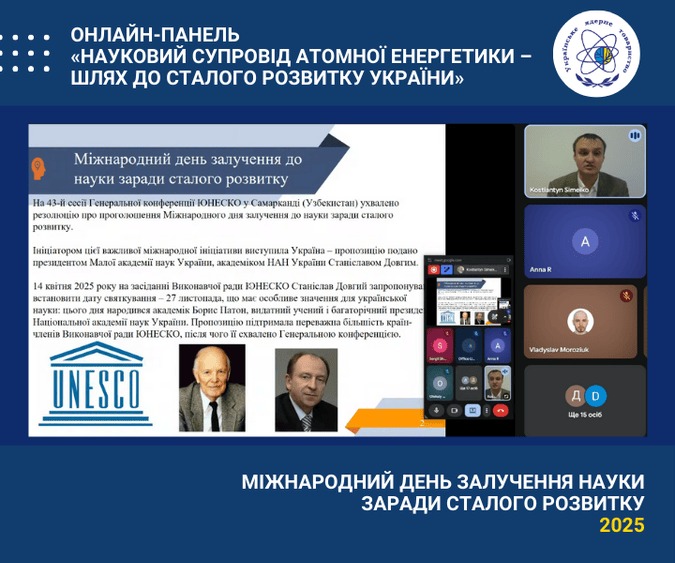
On November 27, the world marked for the first time a new international observance initiated by Ukraine and supported by UNESCO – the International Day of Engagement in Science for Sustainable Development. This date holds special significance for Ukrainian science: it coincides with the birthday of Academician Borys Paton, an outstanding scientist and long-term President of the National Academy of Sciences of Ukraine (NASU). It is also the day when, in 1918, the *first joint meeting of the Ukrainian Academy of Sciences (now NASU) took place, at which Volodymyr Vernadsky was elected its first president.
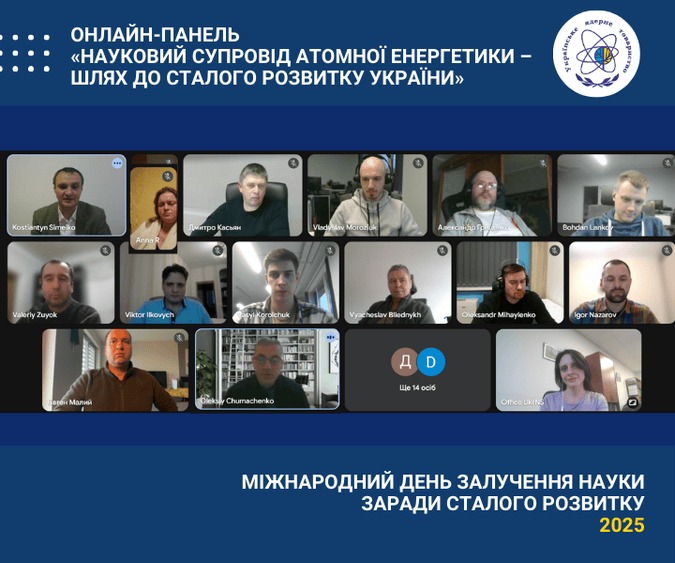
To honor this occasion, the Ukrainian Nuclear Society and the Institute for Safety Problems of Nuclear Power Plants (ISPNPP) of the NAS of Ukraine organized a discussion online panel titled “Scientific Support of Nuclear Energy – the Path to Sustainable Development of Ukraine.”
The event gathered representatives of Energoatom, ISPNPP NAS of Ukraine, the National Science Center “Kharkiv Institute of Physics and Technology”, the Institute for Nuclear Research of NAS of Ukraine, Energy Safety Group, Atomproektinzhiniring (Energoatom branch), SSE “Ecocenter”, Westron LLC, the H.E. Pukhov Institute for Modeling Problems in Power Engineering, Impulse, Energorisk LLC, and the Gas Institute of NAS of Ukraine.
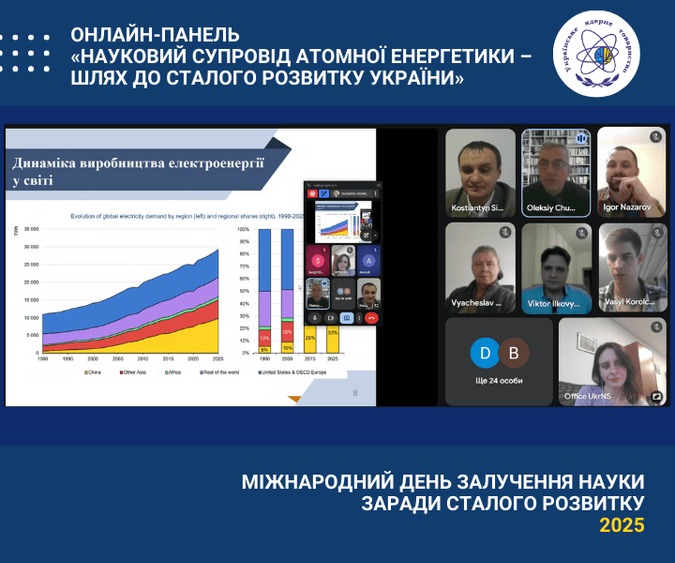
The panel was moderated by Dr. Konstantyn Simeiko, Scientific Secretary and Head of Laboratory at ISPNPP NAS of Ukraine. In his presentation, he traced the path of nuclear energy from fundamental science to stable electricity and heat generation, highlighted global trends in the nuclear sector, the development of **innovative Generation IV nuclear systems, and the role of Ukrainian research institutions in ensuring scientific support for nuclear energy. He also addressed the issue of the declining number of young scientists in Ukraine, suggesting the creation of a cluster of young researchers from various institutions to jointly contribute to the development of Ukraine’s nuclear energy, especially during the post-war reconstruction period and the construction of new nuclear reactors.
Participants discussed the strengths and weaknesses of small modular reactors (SMRs), the priority of constructing large-capacity nuclear power units, the transfer of scientific and engineering experience, the preservation and formation of new scientific schools and research areas in nuclear science, the commercialization of related technologies, and the promotion of Ukraine’s nuclear science and energy prestige at the international level.
At the conclusion of the discussion, participants agreed that despite the war and financial challenges, Ukrainian scientists remain active and productive, achieving significant results in both scientific support and the development of advanced nuclear technologies. Nuclear energy was reaffirmed as a key driver of Ukraine’s sustainable development.